Showing posts with label money. Show all posts

Sunday, July 22, 2012

Eighty twenty

I think I might have done too much rest (that is, from blogging) thanks to my previous post. My other side had been quite filled up, it's really sick season these past few weeks both in the clinics and in the hospital. Actually had just been back from a seminar and some respite, I might as well post on the same topic as promised.

The world literally had trained us to keep busy if we want to go up the ladder of success. Tim Ferris puts this in a graphic tone as follows: "If you want to move up the ladder in most of our corporate world, and assuming they don't really check what you're doing (let's be honest), just run around the office holding a cell phone to your head and carrying papers from 9 am to 5 pm. Now that is one busy employee". Unfortunately ( or quite fortunately), that's not how you increase your results and attain objectives.

Being effective is different from being efficient. Effectiveness is doing the things that get you closer to your goals. Efficiency is performing a given task ( whether important or not) in the most economical matter possible. Sadly, being efficient without regard to effectiveness is the default mode of the universe.

It is no different to you to see so many people working in a company or more so in the government, when you visit their offices. It would surprise you why even with so much manpower, you find yourself with so much people waiting like you in a queue where the service staff seem to have no regard for your personal time. Then observing them closely, some of them just chatting with each other, some just having their eyes fixed to their documents not even looking at you when they talk to you, and most just running around in circles. All for the routine of just to consume their 9 to 5 regimen. It is a wonder why it takes months just to get some simple government permits done. The society is infected with AIDS (As If Doing Something).

Applying this to your life, there are two truisms to take note of.
1. Doing something unimportant well does not make it important.
2. Requiring a lot of time does not make a task important.

Enter this principle of a renowned economist who lived from 1848 to 1923, Mr Vilfredo Pareto. The principle he conceived and presented then is now one of the secrets of the most successful people in the world. His Pareto principle is more popularly called the "80/20 principle". 


His principle originally describes how uneven the income distribution was in all parts of the world. "80% of the wealth and income was produced by 20% of the population". But this proportion is found actually in almost all aspects of human life.


  • 80% of the outputs result from 20% of the inputs.
  • 80% of the results come from 20% of the effort and time.
  • 80% of company profits come from 20% of the products and customers.
  • 80% of all stock marketgains are realized by 20% of the investors and 20% of an individual portfolio.

So with this in mind, here are two basic questions which you should work on to free your precious time (as recommended by Mr Tim Ferris in his book "The Four Hour Work week)".

1. Which 20% of sources are causing 80% of my problems and unhappiness?
2. Which 20% of sources are resulting in 80% of my desired outcomes and happiness?

Just set an entire day to ponder on these questions and write and record your answers in each aspect of your life ( family, business or career). Your goal is to find your inefficiencies in order to eliminate them and to find your strengths so you can multiply them. 

Being overwhelmed with things to do is often as unproductive as doing nothing and is far more unpleasant. Being selective- doing less- is the path of the productive. Focus on the important few and ignore the rest.

It;s easy to get caught in a flood of minutiae, and the key to not feeling rushed is remembering that lack of time is actually lack of priorities. Take time to stop and smell the flowers...


"One does not accumulate but eliminate. It is not daily increase but decrease. The height of cultivation runs to simplicity. - Bruce Lee

Thursday, June 7, 2012

Enforcing life changing habits into your own "comfy" life

It was almost 11 days ago when I last posted here. Tsk tsk to think that I plan posting daily as much as I could when I made this blog a month or so ago.

To ensure this, I changed my Yahoo homepage to blogger (it has been Yahoo since I "discovered" the internet about 12 years ago). This is to constantly remind me that when I begin to surf (which I do daily), I would get subconsciously "forced" to write a short piece to share to the world before I get lost in my emails, Twitter, and FB...

Apparently, starting a new habit is really hard. Life always get in the way. There is this call (referrals/ admissions) from hospital A, then hospital B. There is this habit of patients to come in your clinic when you are about to have your lunch ( clinic time is 10-12 in am, not much to see when you arrive early but a throng arrives at 11:45am) so you finish almost 2 pm very hungry. And when you are to come home for dinner ( clinic time in pm is 4:30 to 7pm, the gang cluster of patients arrive around 6:45pm) so you finish almost 9pm and when you come home, the kids are usually asleep and you take your dinner watching the last batch of telenovelas for the day and you're so poofed right after, you lost consciousness the moment your back hits the bed.

Beyond the medical life, there are too many distractions also. Your wife who is equally busy with her patients suddenly asks you to bring the kids to the dentist for their dental appointment (Yep, I have a 2 hr window to travel from Dau after my morning clinic to Bacolor to have lunch, bring the kids to the dentist in Angeles, wait for them to finish,  to bring them back to our home in Bacolor and then catch my 4:30pm clinic in Dau....whew). If not dental appointment, maybe their singing and painting lessons and of course, our tutoring them on their classroom assignments, etc. Yep, life is SO SO filled up and busy for me......... Well, that's what it appears to be..... but I chose NOT to be.

Yes each of us have 24 hours a day to spend on what we think will make us feel good (well not really everything is spent actively, take off at least 6 hours for sleep, so 18 hrs). But honestly, many of us spend at least 3 hours of television everyday. 18 hrs of awake time, 3 hrs of TV time..that's 1/6 of our lives awake infront of the TV  ( about 85 hours of TV a month!). And I can't understand why many of us (me included) could not spend at least 20 minutes a day writing down what you want to do with your life (believe me it should not be just work and FB!) for the next 5, 10, and 20 years. Or spend the same amount of time learning something new beyond your daily routine/ work, Or sharing what you already know to others so you can make a statement in the world (like what I am supposed to do with this blogging). 18 hours a day for each of us human beings...whether very poor or very rich...and it's how it is properly spent that makes a man poor or rich.

They say if you want to start a good habit right and regularly, set a fixed time of the day to do it. Some prefer the moment they wake up, some right before sleeping. Sigh, I know too much principles but I still have to work these principles into my life.

I would be reading self discipline and time management articles/books this week and would share them to you thru blogging in my next posts (which I hope would be just a few days from now.  Ciao!

Yesterday is history, tomorrow is a mystery, today is a gift, that is why they call it the present.“
Kung Fu Panda

Friday, May 11, 2012

How to dispose off your money

Had just attended our annual convention for internists and the three days had been quite a stretch with all the lectures & sessions presented. I made it a point to attend some sessions which are non- medical in nature. Two of such were this lecture from Ms Susan Bigay, a very astute yet feisty CPA practitioner who shared some tips on how to build your finances & Dr Sanjiv Chopra, a medical practitioner who became an international hit with his numerous publications on success and leadership.

I would like to share some highlights of their lectures. Mrs Bigay reminded the audience, many of which were also young doctors, not to rush into buying expensive flashy cars and building their dream house in the first 10 years of their practice. Well aside from it would certainly attract our friendly government revenue collectors, it is not a wise decision in the long run since you would only be working HARD to pay your debts to something which will just let you lose more money ( the car and house maintenance costs, the gasoline, the decoratives/ fixtures you have to add to your house, the food and time expenses you let out being the gracious host that you are since your house will be a magnet for reunions, meetings, etc.).   That would be stressful just to maintain that lifestyle early. Kiyosaki calls them doodads or liabilities in his book "Rich Dad, Poor Dad".

For the first few years of your earning life, build assets (things that will help you earn money) so that after a decade or two, you have them assets (e.g., rental properties, stocks/paper investments,  businesses manned by others) to help you EASILY build that dream house/ buy that yearned car. Live it simple and do not rush...


Mrs Bigay, on another point, emphasized the idea that we should not keep all our money and savings in the banks. The time deposit interest which goes to about 2-3 % per annum is substantially less than our current inflation rate which is about 5%. So in the long run, you are literally losing money ( the buying power of the money you kept in that TD is slowly dripping away). What more in case of bankruptcy, the bank thru the Philippine Deposit Insurance Company (PDIC) can only guarantee P500,000 to each depositor no matter how many accounts or TDs he has with the bank. And to make it more inconvenient, the time frame to retrieve the lost money is about 6-8 months.

She advised to keep only your emergency fund in the bank ( like the amount equal to the basic family expenses you would incur in 6 months assuming you lost your job and you're without any pay in the same time period). Money in the bank should be mainly for safekeeping. She recommended diversifying your investment portfolio into UITF, mutual funds, stock market, stocks in time tested companies and promising businesses and real estate. Relative to this what came to my mind was this very useful video resource series "Pesos and Sense" by Mr Aya Laraya which I strongly would recommend to the average Filipino saver/investor.

On my next post, I would share Dr Sanjiv Chopra's talk on leadership and steadfastness to a dream.


The greatest invention the world had ever known is compounded interest  -  Albert Einstein


Wednesday, May 9, 2012

Where do we fit in?

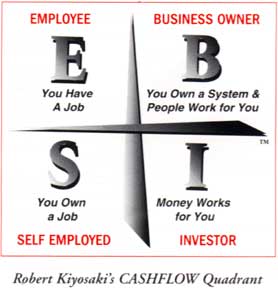
As what Mr Kiyosaki said in his book, "most of us have the potential to generate income from all four quadrants (see figure below). Which quadrant you or I choose to earn our primary income from is not so much what we learned in school; it is more about who we are at the core- our core values, strengths, weaknesses, and interests."
Regardless however of what we do professionally, we can still work in all four quadrants. Coincidentally he cites a medical doctor as an example.

As an "E" - he may be employed as a staff of a large hospital or work for the government in public health service or become a military doctor or join the staff of an insurance company needing a doctor on its staff.

As an "S" - he may start a private practice, setting up a clinic, hiring staff, and building his private list of patients.

As a "B" - he may own a polyclinic or laboratory or hospital and have other doctors on the staff, then he may hire a business manager to run the organization. He could also decide to own a business that has nothing to do with medicine.

As an "I", the doctor also could generate income from being an investor in someone else's business or in vehicles like the stock market, bond market, and real estate.

Making use of other people's time (OPT) and other people's money (OPM) is the main secret of the rich. OPT and OPM are found on the right side of the quadrant. For the most part, people who work on the left side of the quadrant are the OP (Other People) whose time and money are being used.

So the better trend to get most of your income from the B and/or I quadrant with time. If your only source of income is from your job ( the E side), there is a setpoint limit as to what you can earn ( your company or boss dictates it) and you are the most highly taxed by the government. All you get is after tax money.

It is quite frustrating to see hordes of laborers complaining about minimum wage and making noise about them deserving more. The legendary success mentor Jim Rohn says " You don't get rich by demand, you get rich by providing value". So yes, you can provide more value if you do your best as an employed but better value can be given as a business owner (entrepreneur) or as an investor (e.g., providing very good residential solutions at a very reasonable price like when you're into real estate investing).

If you are solely the S quadrant type (they are also called the do-it-yourselfers), being successful here would mean more work as you get more clients, so it would be virtually impossible to take a day off.

So now I invite you to take the time to plan and make a gradual extension and/or shift to the right side. Be it in the next few months or years, it is really possible. Nope you don't have to resign your day job right now, create something of the B or I quadrant on the side. You just have to expand your mindset. This is where the real wealthy are...


"Try to work very hard on yourself than you do on your job.
If you work hard on your job, you'll make a living..
If you work hard on yourself, you'll make a fortune..."         -   Jim Rohn